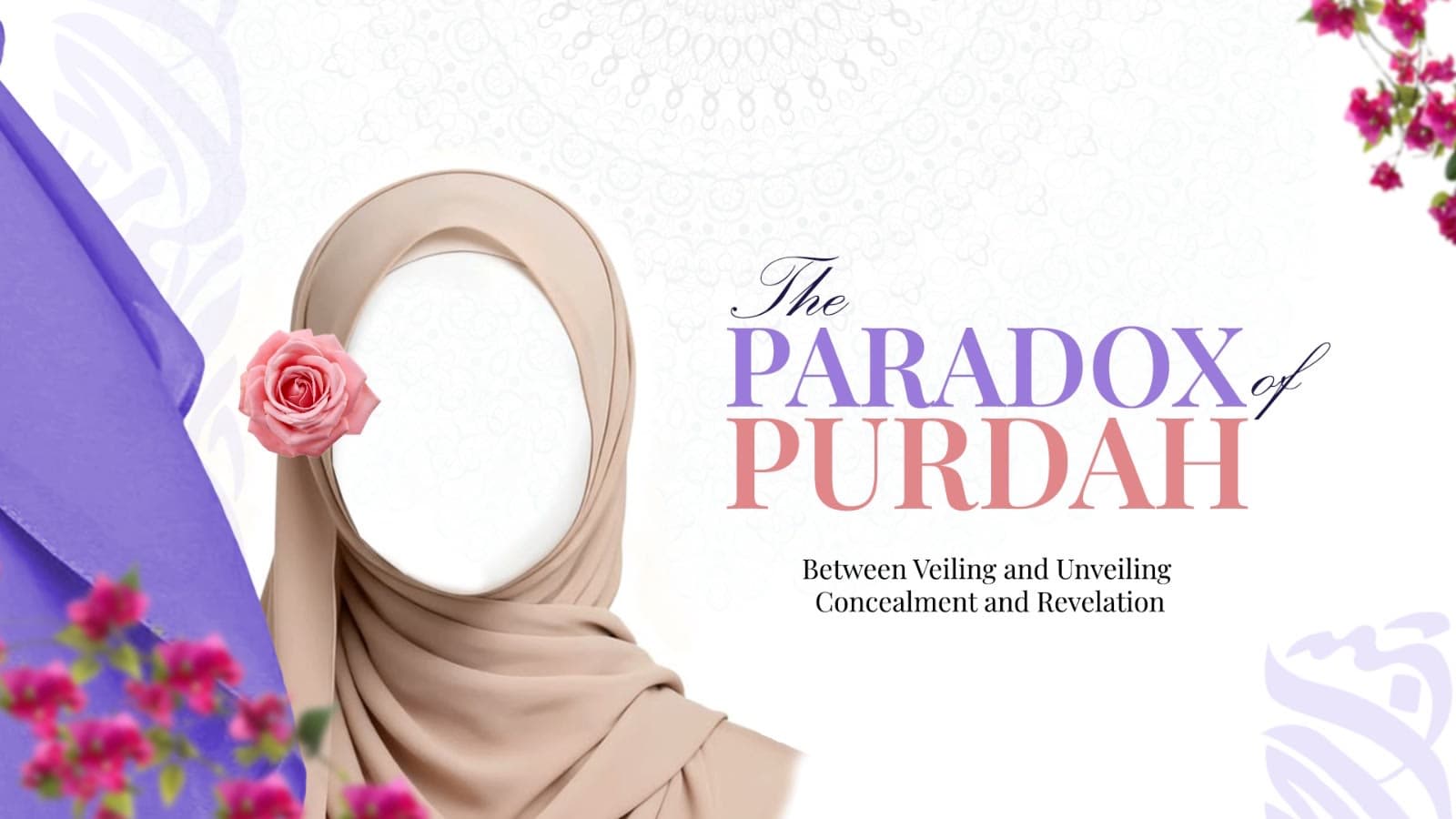
The donning of the ‘purdah’ (religious head covering)—in the form of hijab, niqab, burkha, and chadar—within the exoteric realm of Islam remains a polarizing debate across both the Islamic and non-Islamic world. Women are routinely dictated, disciplined, harassed, and even sensualized through the concept of the ‘purdah’. Its enforcement and its banning are equally fraught.
Yet when the word purdah is uttered, what almost exclusively comes to mind is the literal bodily covering for women. The conversation remains trapped at the level of materiality and gender. When the word ‘purdah’ is evoked, our mind instantly goes to the bodily and shame-based rendering of the term. In this simplification, something far more expansive and esoteric gets lost.
Within the esoteric-gnostic traditions of Islam, particularly in Sufi thought, purdah carries a radically different meaning. Within Sufi discourse, purdah is more than a social prescription. It is read as a metaphysical condition.
There exists a sublime understanding that even Allah dons the purdah—veiling Himself lest His creations be dazzled, even annihilated, by the intensity of His presence. Yet it is also through this very veil that the Almighty reveals Himself to His creations. The veil does not simply conceal; it mediates revelation, depending on the degree to which the creation is able to receive the intensity of His countenance.
"In this sense, purdah is not an obstacle to truth but its very architecture."
This paradox sits at the heart of Sufi metaphysics. As articulated by thinkers like Ibn Arabi, the Divine is simultaneously manifest (zahir) and hidden (batin)—disclosed and withheld—through the process of divine veiling and unveiling. The veil is not the cancellation of divine presence but the only condition that makes the Almighty visible to human sense-perceptions. To encounter the Divine is not to strip away all veils in a single moment, but to move through levels of unveiling, each layer both concealing and revealing.
There is also a direct and intimate relationship between ma‘rifat (gnosis) and purdah. The esoteric realm of Islam cannot be exposed all at once, as the knowledge itself could confuse and overwhelm the receiver. Ma‘rifat must be safeguarded through veiling, and devotees must go through degrees of initiation for the knowledge to unveil itself gradually.
Within Sufi traditions, the true seeker is not one who rejects the veil outright or unveils it at one go, but one who learns to traverse it nimbly over time. Within Sufism, the journey towards God-consciousness is itself shrouded within layers of veils, the unveiling of which requires deep devotion, patience, and inward seeking.
The unveiling of the qalb (heart), which itself remains veiled by layers of ego, greed, hatred, self-importance, and envy, must also be removed in time. According to many Sufi dervishes and scholars, these are the real veils—thicker and more blinding than any cloth.
To remove these veils requires discipline of a different order: not the policing of the body, but the refinement of the self through prayer, remembrance, and sustained inner work. Only then does the “real” self begin to emerge—glimpsed through the purdah, but never to be fully unclothed.
When purdah is reduced to its strictly material interpretation, it takes on a coarse and diminished meaning. The satr—the body—becomes the sole object of attention, and the concept becomes only materially rendered. The richness of veiling as a metaphysical and ethical process is eclipsed, replaced by a fixation on surface and compliance.
Without a bateni (inner) understanding, veiling is no longer a practice of becoming but a tool of disciplining. Purdah then becomes only a rule to be invoked, rather than a process to be gradually refined.
This flattening does not occur in a vacuum. The modern obsession with regulating women’s visibility—whether through enforcement or prohibition—emerges from a convergence of colonial and reformist anxieties. Victorian moralities, colonial governance, and postcolonial state projects have all contributed to narrowing the meaning of purdah into something materially legible, enforceable, and controllable.
In this translation, purdah is stripped of its metaphysical ambiguity and bateni (gnostic) sophistication and recast as a marker of either civility or backwardness, or invoked as resistance or compliance.
The irony is stark. In the Sufi imagination, the veil is what allows the unseen to be encountered without destruction. In modern discourse, it is treated either as an oppressive barrier to be removed or as a rigid boundary to be imposed. In both cases, the deeper meaning of veiling—as mediation, as gradual unveiling, as ethical labor—is erased.
Perhaps the most pervasive veil, then, is not the cloth itself but the insistence that purdah can only be understood through it.
What would it mean to return purdah to a language of perception rather than control? To think of veiling not as the management of women’s bodies, but as the cultivation of the self’s capacity to encounter truth without being overwhelmed by it? Or a means through which Allah Himself simultaneously veils and reveals Himself to His creations?
And more unsettling still: what if the loudest debates about unveiling are themselves the thickest veils—obscuring not women, but the very possibility of seeing differently?